
The Midwest Magnet: Why New Waves of Capital are Targeting Indiana Multifamily Markets
Blog Article Written by: Steve LaMotte, Jr.
Managing Director | Investment Sales
Walker & Dunlop
Over the past several months, the landscape of multifamily investment in the United States has undergone a profound shift. While coastal metros and “smile markets” once dominated institutional acquisition strategies, a striking new trend has emerged: the Midwest—and Indiana in particular—has become one of the most attractive destinations for fresh capital deployment. In markets such as Indianapolis, Columbus, Kansas City, and Louisville, the pace and scale of institutional participation have accelerated, signaling not a temporary curiosity but a structural reorientation in how capital views the region’s multifamily fundamentals. And this shift has been rapid and convincing.
This shift is especially evident in Indianapolis, where a blend of affordability, stability, and scalability has positioned the metro squarely at the center of investment committees’ maps. Crucially, this wave of capital is not just arriving—it is competing, winning, and driving meaningful pricing outcomes. For the first time in the modern era of real estate investing, the Midwest is no longer a “yield play” outlier; it is now a core allocation target for multiple national groups. Markets once relegated to flyover status have acquired deep conviction that “the plane must now land”, signifying a new wave of capital deployments.
Why the Midwest—and Indiana Specifically—Has Become a Capital Magnet
1. Affordable Rents Paired with Affordable Basis
Perhaps the most widely cited reason for new investor interest is the region’s compelling combination of achievable rents and attractive acquisition basis. Compared to coastal and Sunbelt markets, where pricing has pushed up to record highs, the Midwest offers relative value, and the investor market is very focused on basis as a ration of replacement cost. Most assets trading across the nation in the apartment space are trading at a requisite discount to replacement cost. That box is soundly checked in the Midwest.
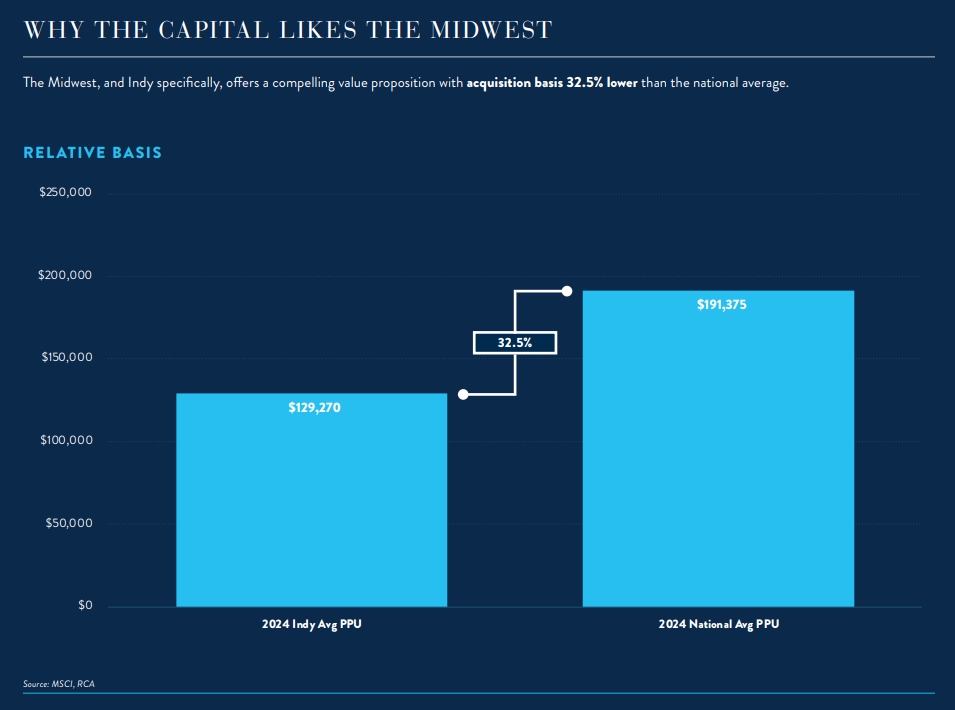
Rents are accessible to the average resident, which reduces political pressure to implement rent control, enhances long-term occupancy stability, and positions properties to outperform during economic volatility. Meanwhile, acquisition basis remains materially below replacement cost, giving investors a critical margin of safety.
This equilibrium—affordable for renters, sustainable for owners—has become a defining competitive advantage for markets such as Indianapolis.

2. Immediately Underwritable Rent Growth and Absorbable Levels of Supply
Despite maintaining a reputation for stability rather than explosiveness, the Midwest has repeatedly demonstrated reliable and underwritable rent growth. Investors increasingly value markets where projected rent growth is not speculative but supported by real economic demand. In short, many investors lie to themselves by placing a positive rent growth number in year-one of their acquisition model in most markets outside the Midwest. This is not the case in Indiana. Investors can honestly apply organic rent growth to their year-one in most markets in Indiana, a feature not found in many other markets outside the Midwest.
Indianapolis embodies this phenomenon. Over the last several years, rent increases have displayed not only resiliency but consistency—enough that institutional partners now view the market as capable of generating long-term revenue growth without the volatility associated with Sunbelt swings or coastal regulatory constraints.
All of this is augmented by absorbable levels of supply. In the Indianapolis metro for instance, new supply in the Indy metro peaked in 2024 with 6,800 units delivered, followed by 5,000 units to be delivered in 2025 and a forecast of 4,000 units in 2026. While this downward trend exists in most markets throughout the country, the gross numbers of deliveries are often times multiples of what we see in the Indianapolis metro for instance.
3. A Stable, Diverse Labor Market with Logistics, Education, and Healthcare Leading the Way
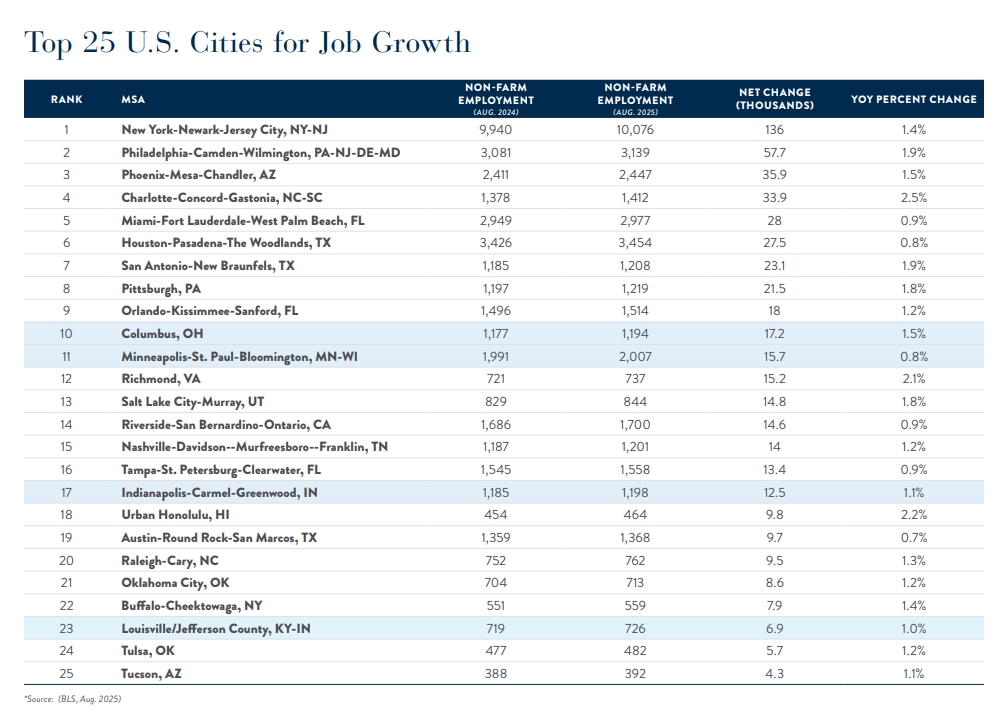
A central pillar of Midwest investment strategy is the strength and breadth of its labor markets. Indianapolis is a textbook example of how economic diversification fuels multifamily stability and is the #17 job growth market in the nation currently.
- Logistics continues to be one of the region’s strongest engines, thanks to its location advantage as the “Crossroads of America.” Global distribution powerhouses maintain massive footprints here, ensuring durable job growth. An estimated 36% of US air cargo runs through the back-to-back contiguous markets of Nashville, Louisville, Indianapolis and Chicago (which Indianapolis generally sits at the center of) and is then pushed up and down I-65 and across the lateral US routes.
The importance of this segment of the Indiana economy cannot be overstated.
- Eds and Meds institutions—including IU Health, Ascension St. Vincent, Purdue University, and others—provide long-term employment stability while fueling population growth and in-migration from out of state. Most notably is IU Health’s unprecedented $4.3B expansion at its facility on the north end of downtown Indianapolis. And IU’s and Purdue’s densification and buildout of their respective campuses in the heart of the city will help to strengthen downtown fundamentals.
This economic balance creates resistance to job loss cycles and supports consistent absorption across multiple asset classes—from workforce housing to Class A housing.
4. Unmatched Ability to Amass Scale Quickly
Another factor driving institutional capital toward Indiana is the ability to assemble meaningful portfolio scale at speed. With a peak multifamily volume of $2.5B in the Indianapolis metro, investors have the confidence in their ability scale. National buyers find this particularly attractive as they seek to place capital efficiently and build operational density. For institutional operators who rely on economies of scale, this is a critical advantage.
5. Zero Likelihood of Rent Control
In an era when political risk is increasingly priced into acquisition decisions, the absence of rent control in Indiana has become a major differentiator. Coastal markets—from Los Angeles to New York—have seen rent control regimes expand, creating regulatory uncertainty and compressing investor appetite. Even in traditionally landlord-friendly Sunbelt states, political rhetoric is shifting.
Indiana stands apart. Statewide legislation makes the implementation of rent control effectively impossible. For institutional investors—whose fiduciary obligations require predictability—this clarity is invaluable. It enables long-term underwriting, stabilizes investor confidence, and boosts portfolio desirability on both the acquisition and disposition sides.
The Shift: The Midwest Has Become an Institutional Priority
For years, the Midwest was viewed primarily as a regional or private-capital environment. That era is over.
We now see multiple institutional sources of capital that are expressly focused on deploying in the Midwest, supported by formal investment theses, dedicated acquisition teams, and long-term pipeline strategies. This is not casual interest—it is a structural shift in allocation behavior.
Equally important, these groups are not simply showing up. They are winning. They are:
- making their way to the top of the bid deck,
- writing competitive offers,
- shortening diligence timelines, and
- closing reliably.
This competitive behavior is reshaping cap rate expectations, elevating asset values, and signaling confidence that the region’s fundamentals will continue to outperform.
Looking Toward 2026: Why Appreciation Is Poised to Continue
If current patterns hold—and all indicators suggest they will—market appreciation in Indiana should accelerate into 2026. The reasoning is straightforward:
- Institutional capital is in motion and needs stable yield. Its appetite is convincing.
- The Midwest provides the best blend of risk mitigation and growth potential in the country.
- Strong labor markets and population stability ensure durable fundamentals.
- Legislative certainty provides long-term protection.
- Transaction volume enables scaling.
As these groups continue deploying with greater intensity, pricing pressure will rise, values will strengthen, and portfolio hold strategies will lengthen, all contributing to continued appreciation across the region.
Conclusion
A new era of multifamily investment has arrived in the Midwest, and Indiana sits at the center of it. What was once considered a second-choice market, has become one of the most strategically compelling markets in the country. With affordable rents, stable growth, diversified employment, policy clarity, and scalable investment opportunities, Indianapolis offers a rare balance that aligns perfectly with institutional objectives.
As capital flows deepen into 2026, the state’s multifamily sector is poised to experience not only growth but a sustained revaluation—driven by structures of demand, not cycles of speculation. The Midwest is no longer the quiet middle ground of multifamily investing; it is becoming the new frontier.